AutoGain — Living Reliability Systems

The World's First Living Reliability System

AI-Powered Reliability Engineering.
From Concept to Field.

21 specialized AI agents. One living platform. DFMEA, PFMEA, FRACAS, and reliability analytics — all connected, all intelligent.

Magnus AI Platform
Magnus Platform
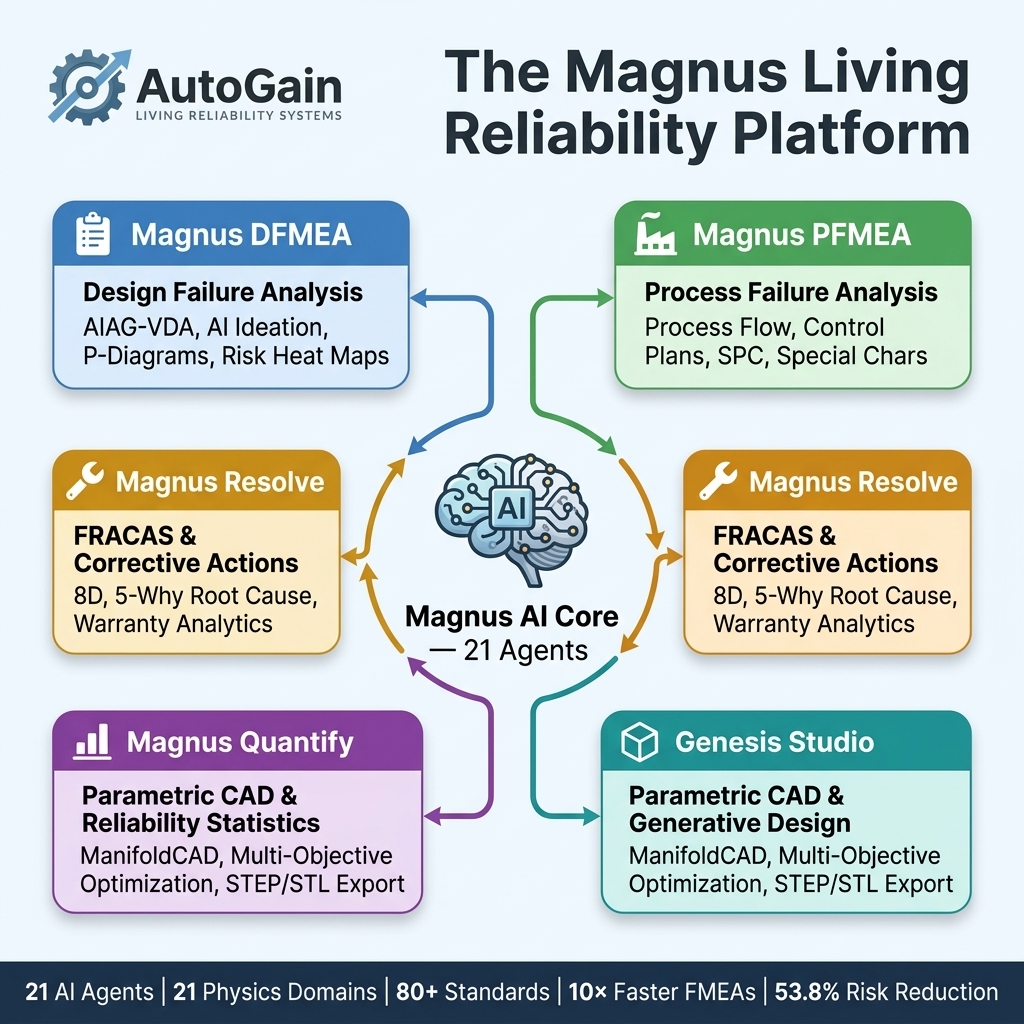
The Magnus Platform
5 apps · 21 AI agents · 1 living loop
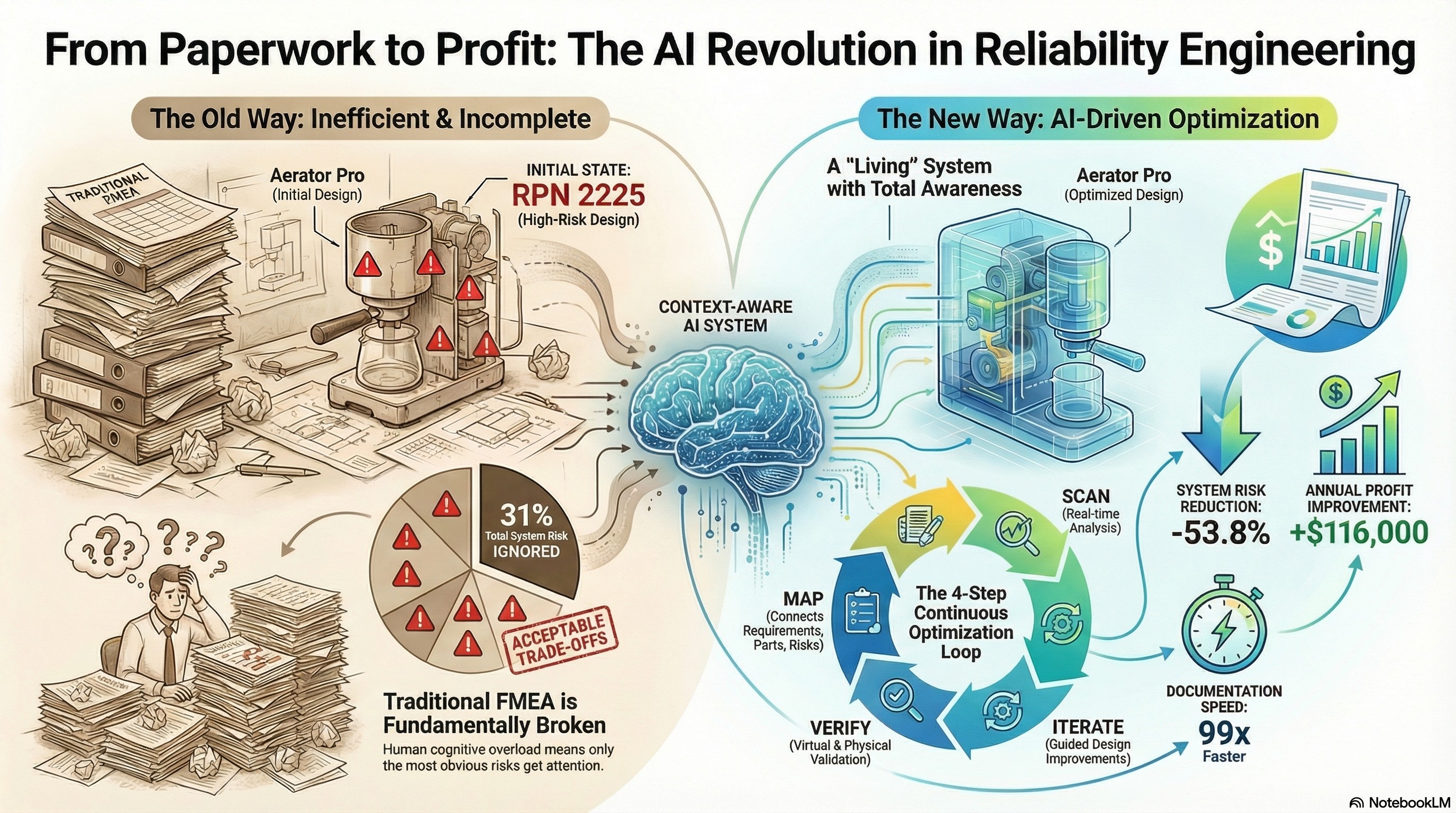
From Paperwork to Profit
AI revolution in reliability
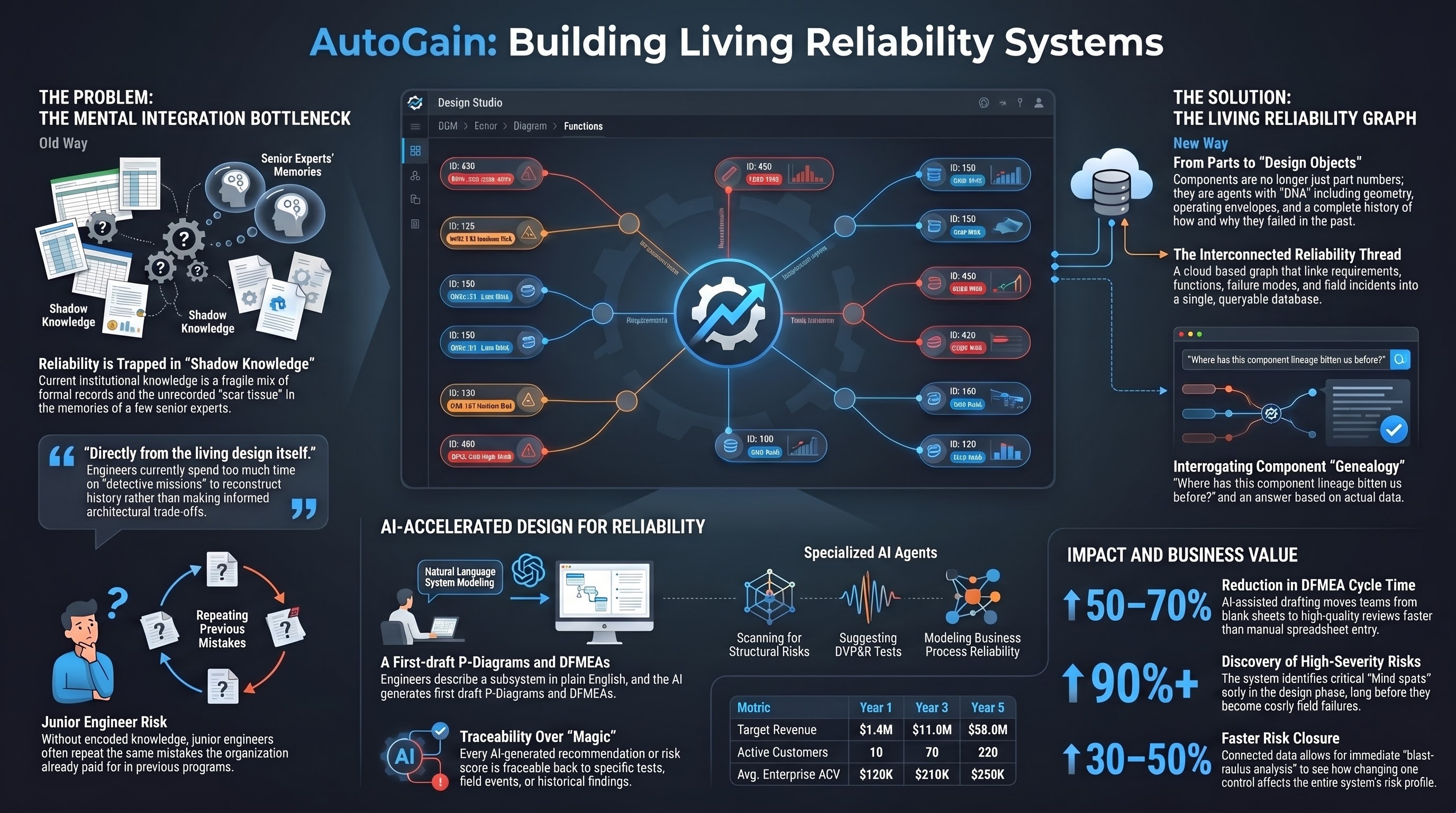
Living Reliability Systems
The Living Reliability Graph
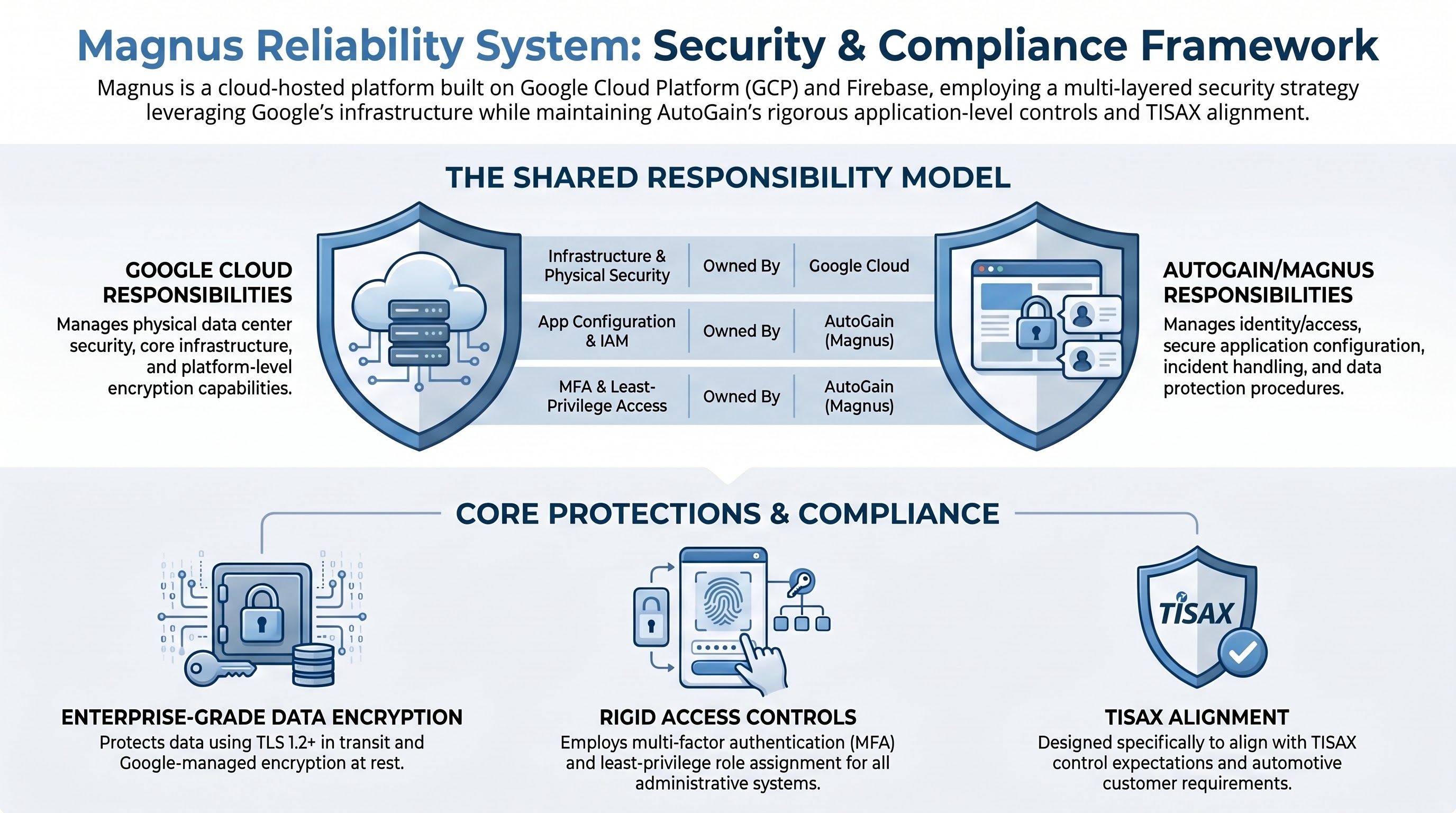
Security & Compliance
Google Cloud · TISAX · MFA
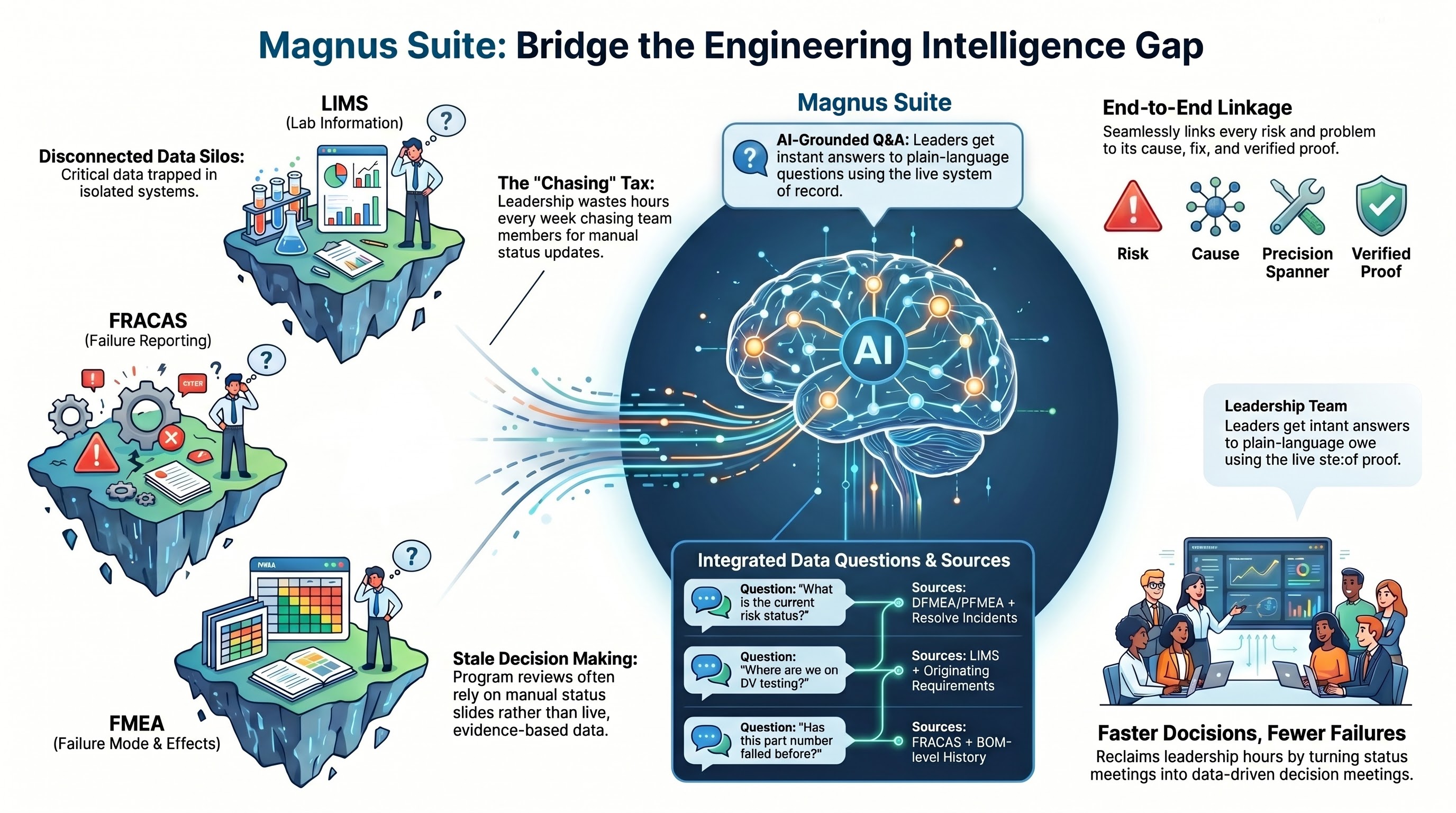
Bridge the Intelligence Gap
AI-grounded Q&A for leaders
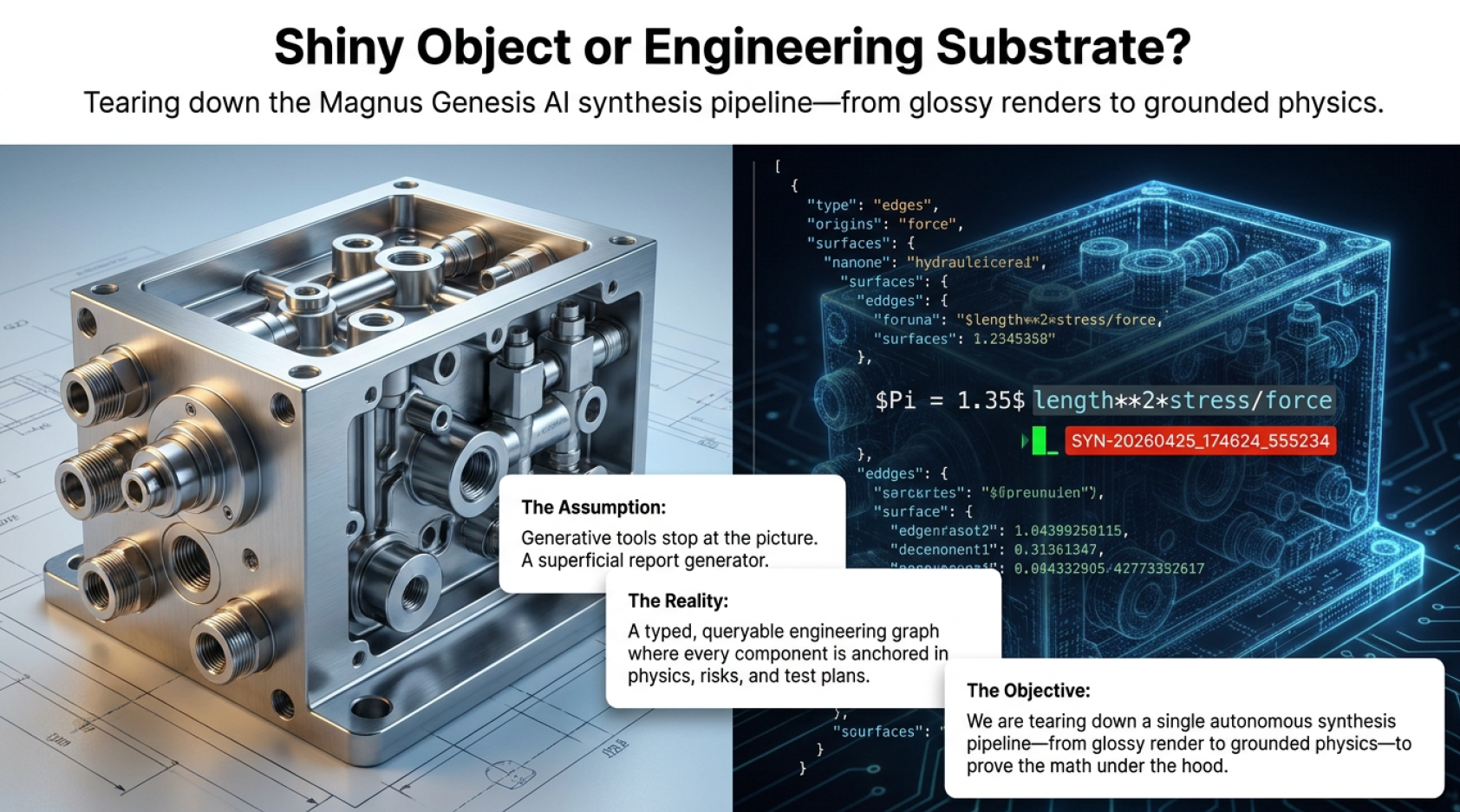
Engineering Substrate
The Engineering Substrate
Foundation under every decision
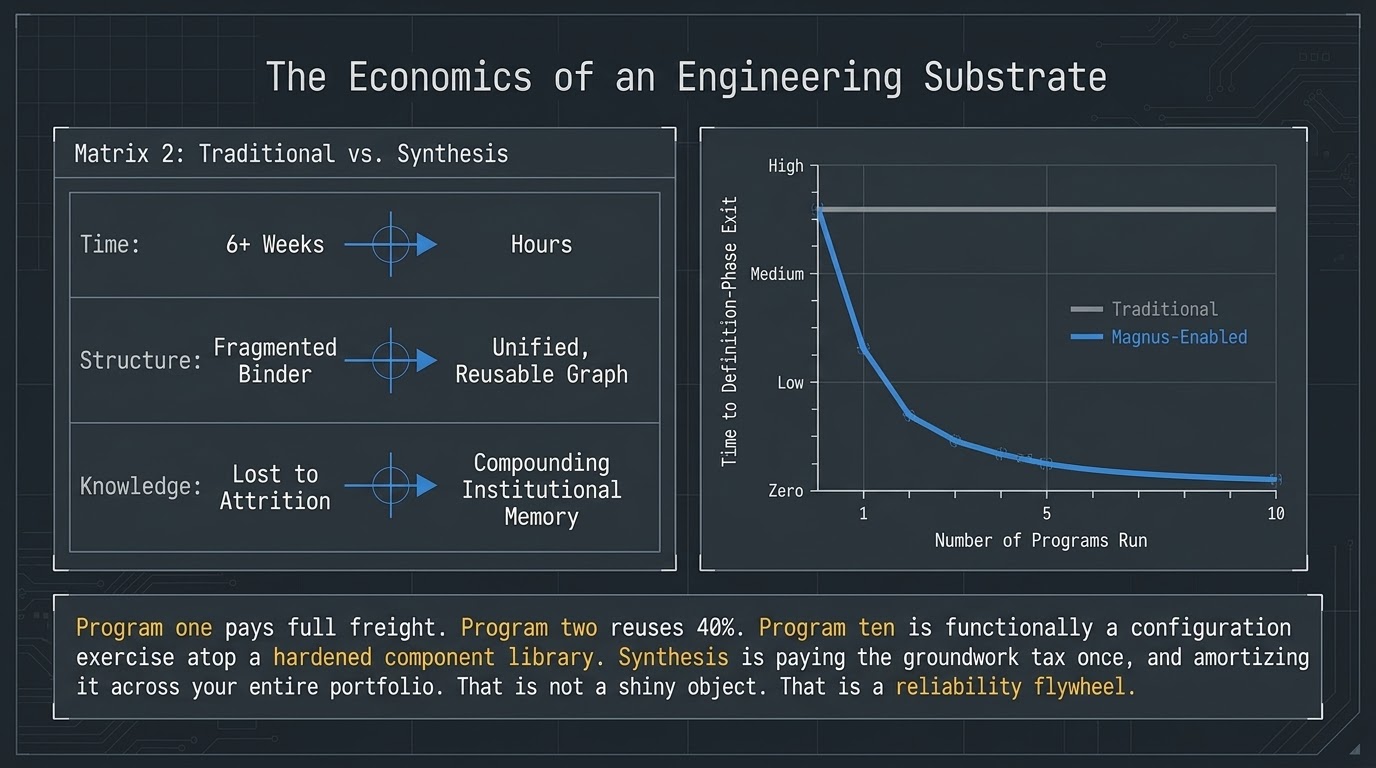
The Economics
The Economics
Reliability flywheel at scale
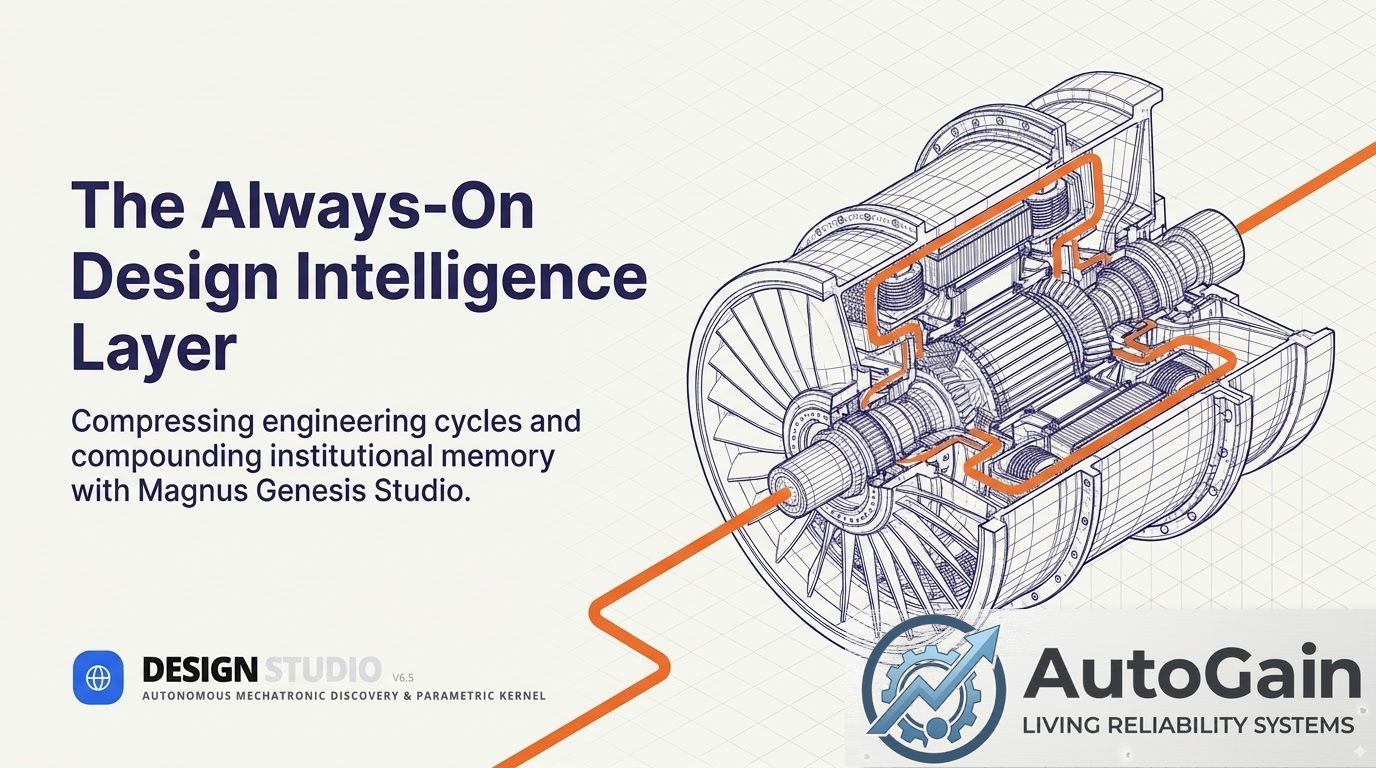
Always-On Intelligence
Reliability data that's alive
Beyond a Part Number
Components as agents with DNA
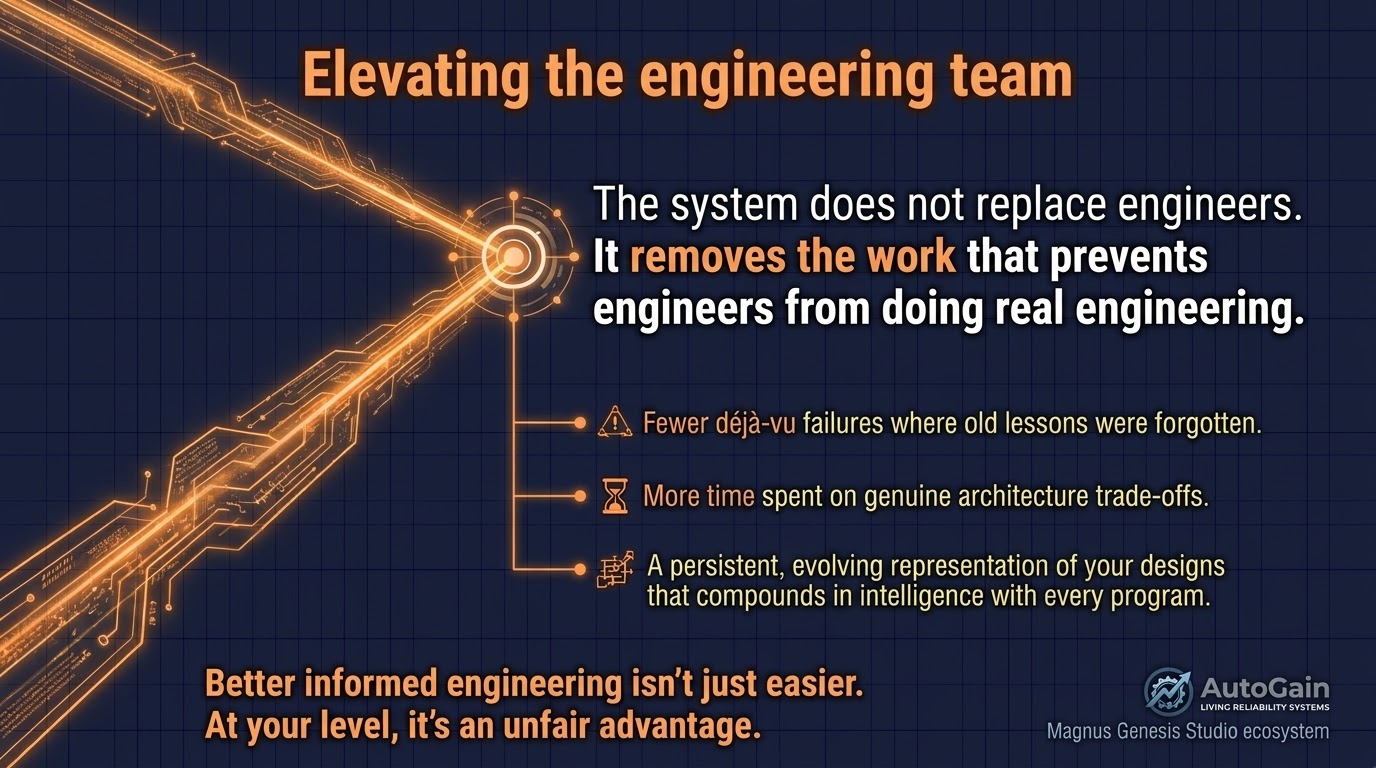
Elevating the Team
Elevating the Team
Institutional knowledge at scale
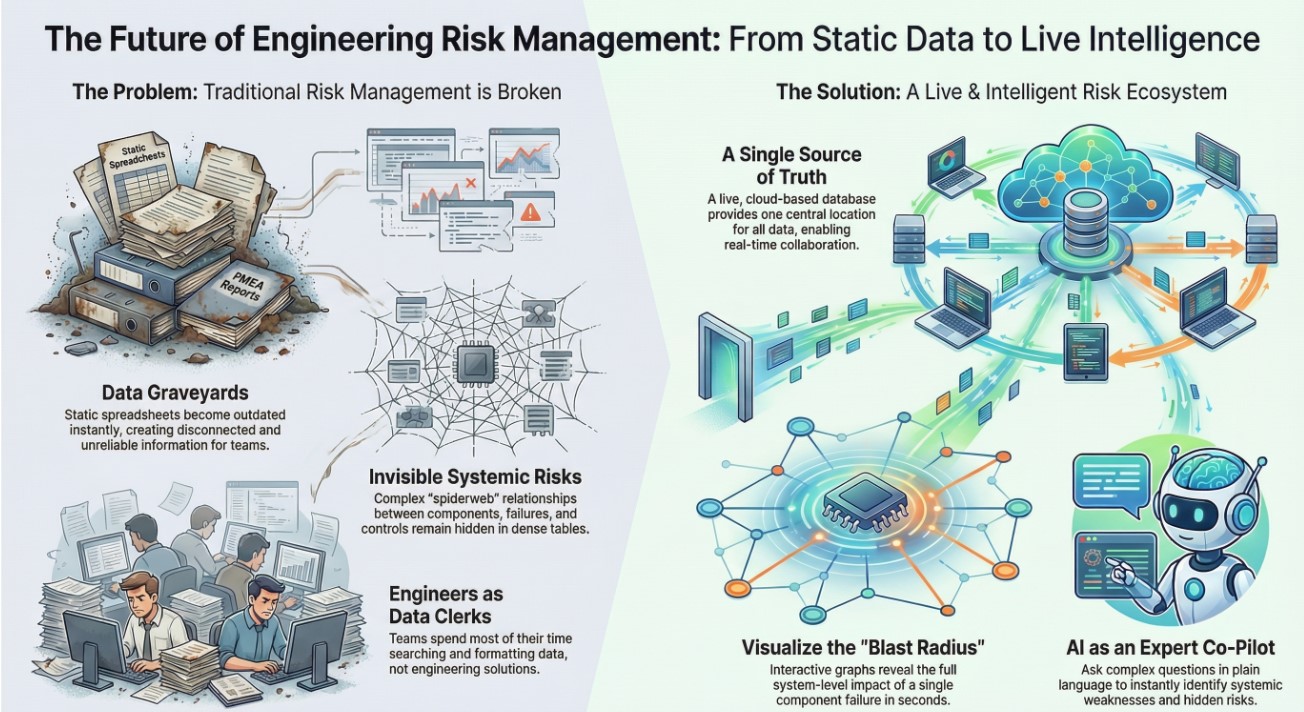
Static vs. Living Data
Dead docs vs. evolving systems
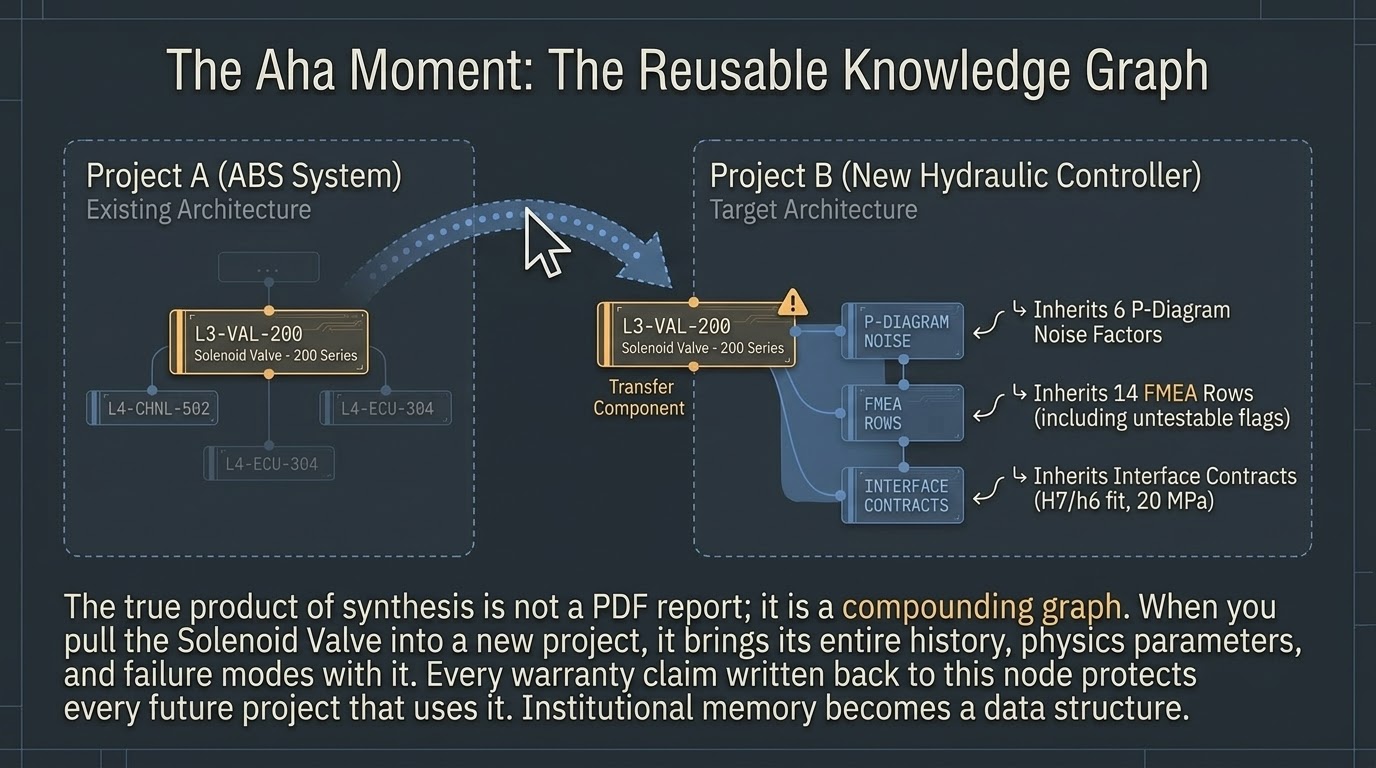
The Aha Moment
The Aha Moment
Cost of disconnected data
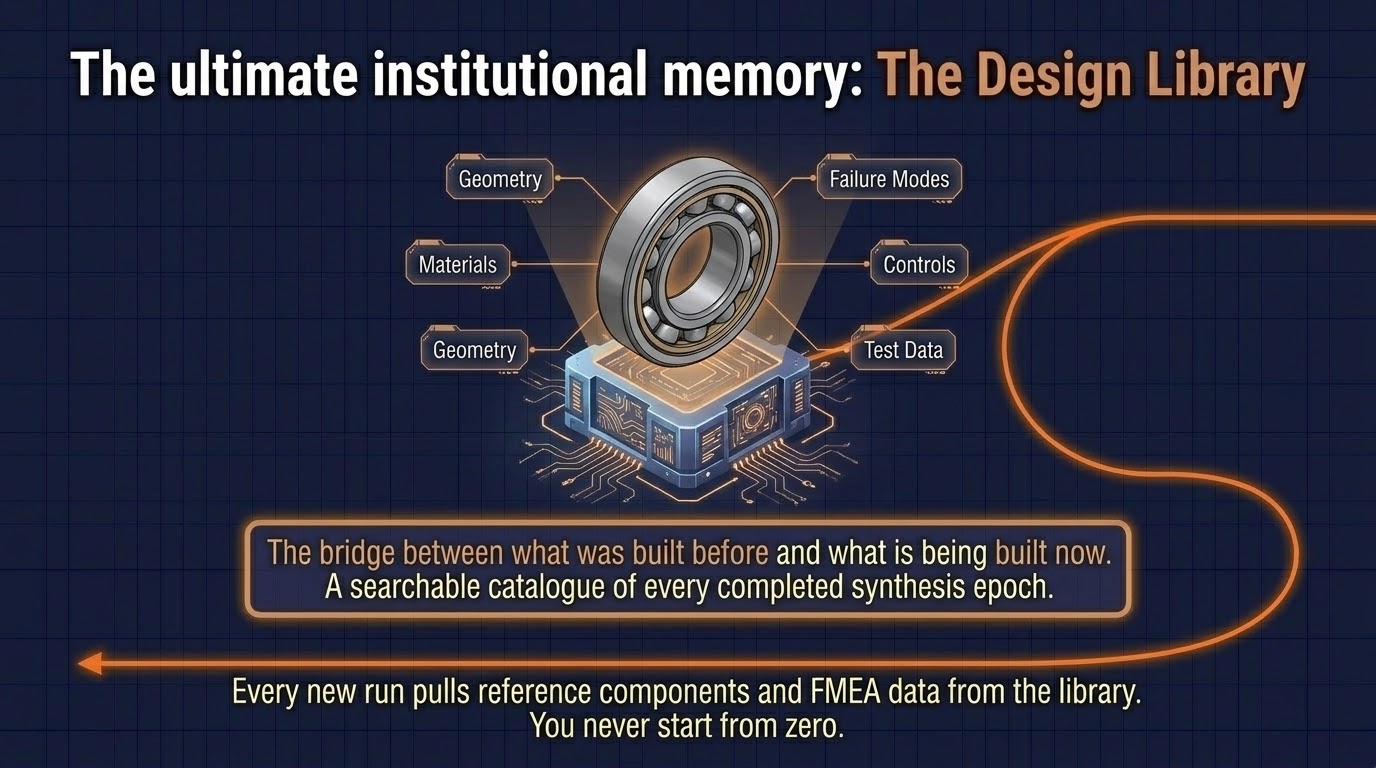
Genesis Design Library
Parametric reuse with reliability
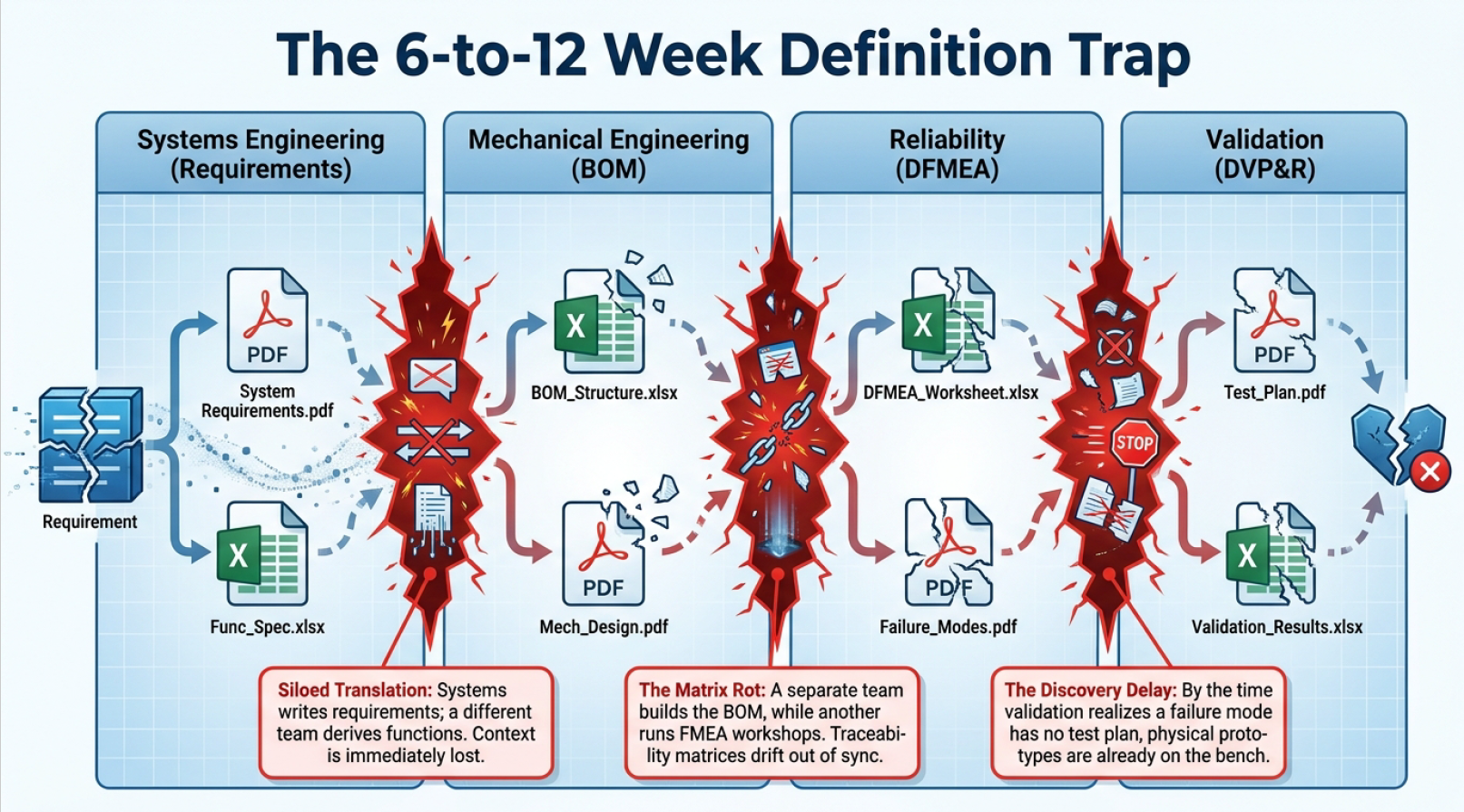
The 6-to-12 Month Trap
Faster deployment, zero lag
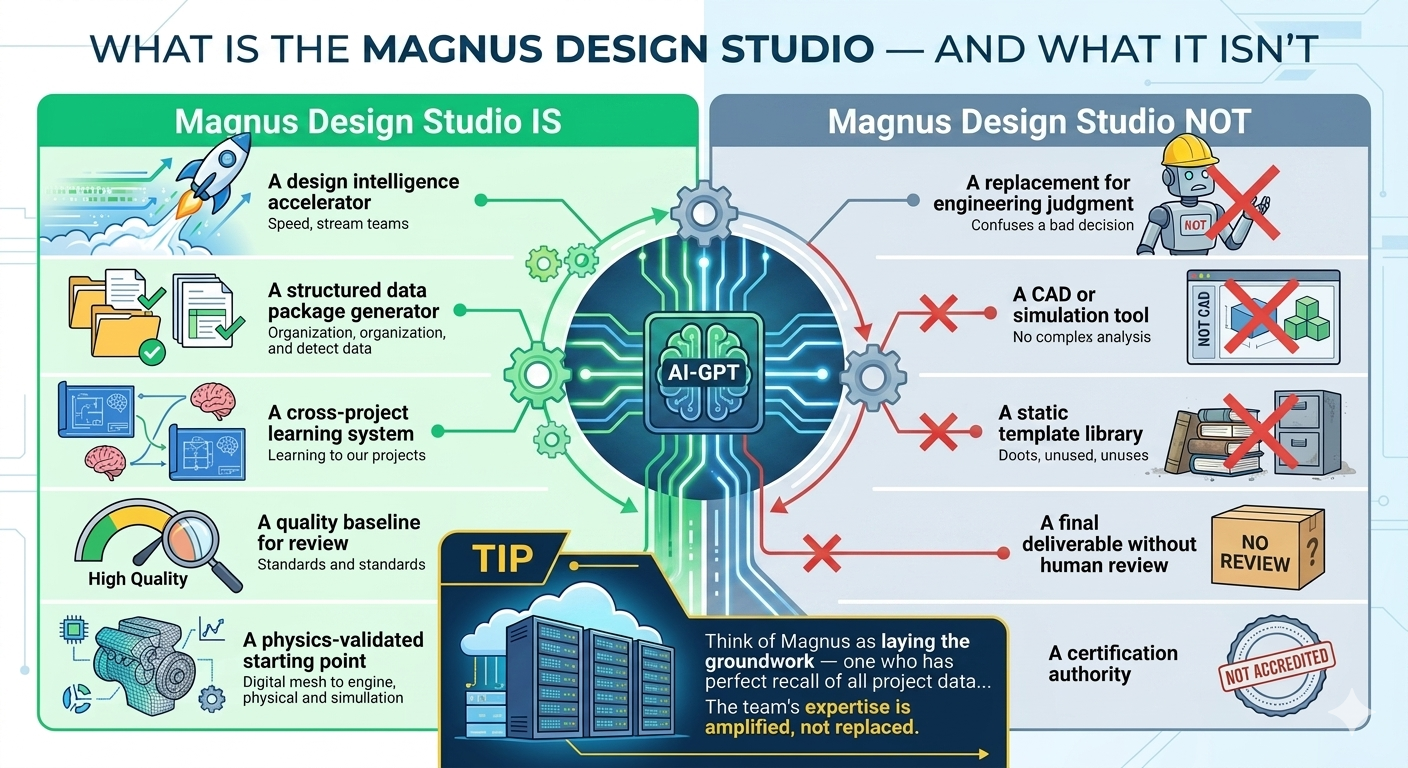
What Design Studio Does
Concept to validated design
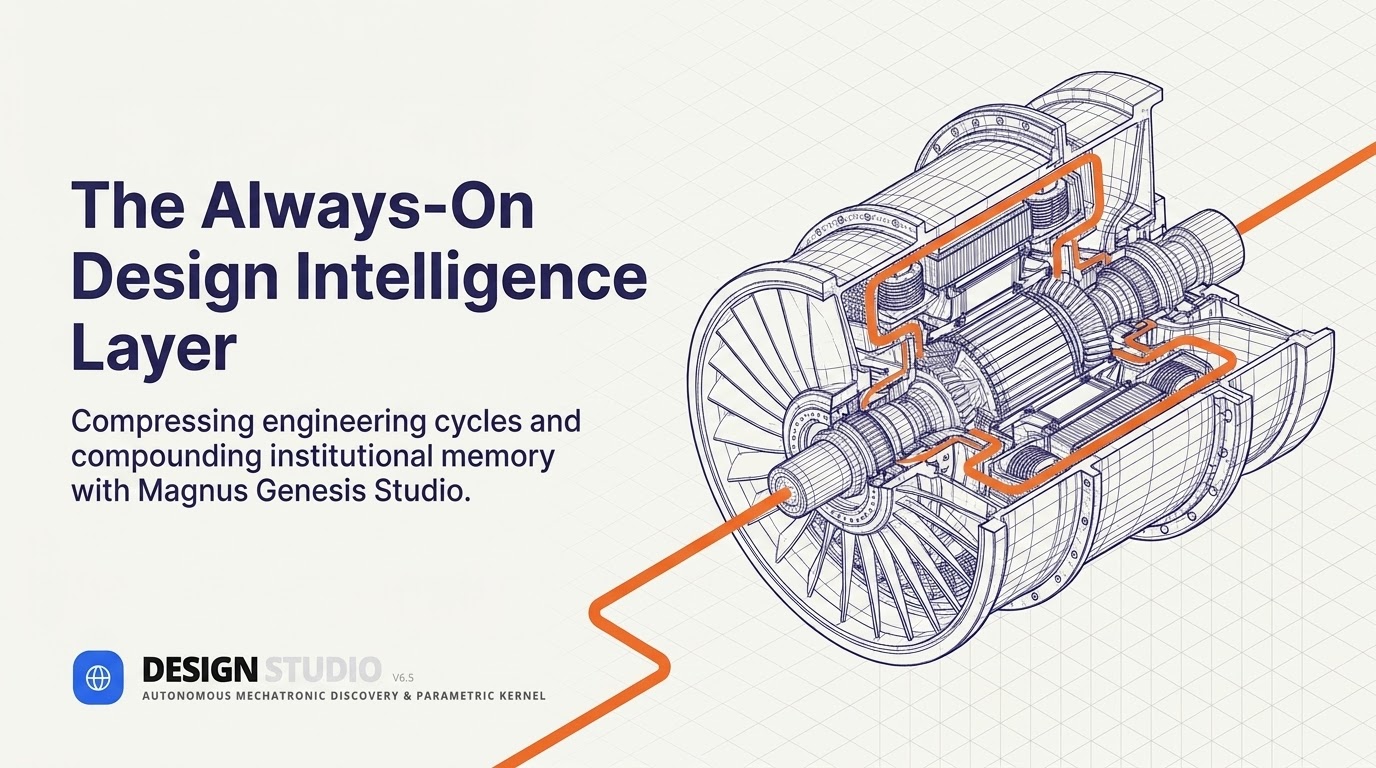
Always-On Design Intelligence
Active monitoring & alerting
Magnus Platform
The Magnus Platform
5 apps · 21 AI agents · 1 living loop
From Paperwork to Profit
AI revolution in reliability
Living Reliability Systems
The Living Reliability Graph
Security & Compliance
Google Cloud · TISAX · MFA
Bridge the Intelligence Gap
AI-grounded Q&A for leaders
Engineering Substrate
The Engineering Substrate
Foundation under every decision
The Economics
The Economics
Reliability flywheel at scale
Always-On Intelligence
Reliability data that's alive

❌ The Old Way

Fragmented Tools

Excel spreadsheets, Minitab, standalone FMEA tools — none of them talk to each other. Knowledge is trapped in silos.


✓ With Magnus

One integrated platform — design, process, field, and analytics all connected.

❌ The Old Way

Weeks of Manual FMEAs

Creating FMEA documentation takes weeks of tedious manual work. Updates never happen, and the document becomes stale.


✓ With Magnus

AI generates comprehensive FMEAs in minutes. Living documents that update automatically.

❌ The Old Way

Field Failures Are Surprises

Customer returns and warranty claims arrive as expensive surprises. No systematic link from field data back to design.


✓ With Magnus

Living feedback loop — field failures automatically feed back to design FMEAs.

⚡ The Intelligence Behind Magnus

Not One Chatbot.
An Engineering Swarm.

Magnus deploys 21 specialized AI agents through a structured SIPOC pipeline — each trained for a specific engineering domain, each validated, each learning from every project.

🤖
21 Specialized AI Agents
Not one chatbot. An engineering swarm.
Overview

Magnus doesn't use one generic chatbot for everything. It orchestrates 21 domain-expert agents through a validated SIPOC Descent Pipeline — from research and requirements all the way through physics simulation, 3D geometry, and quality scoring. Each agent has a specific competency and is validated before its output moves downstream.

Key Agents
Magnus Prime — Orchestrator & conversational assistant (Gemini 2.0)
Physics Agent — Token-free autocomplete across 21 physics domains
Compliance Auditor — AIAG-VDA / ISO standards validation
FMEA Sentinel — Field-to-FMEA closed-loop updates
Vision Defect Agent — Image-based defect classification
🧠
Heritage Learning Database
Every project makes the next one smarter.
Overview

Every validated engineering decision, failure mode, and corrective action is stored in a ChromaDB vector database. When you start a new project, Magnus leverages this cross-project intelligence to provide increasingly accurate suggestions — without re-training the base model.

How It Works
Validated outputs from each agent run are embedded as vectors and stored
New projects query the heritage database for similar designs and failure patterns
Results are ranked by similarity, recency, and validation quality
The compounding effect: Run 1 → Run 2 → Run 3 gets progressively smarter
⚛️
Physics-Grounded Autocomplete
Zero tokens. Sub-50ms. 99.85% accurate.
Overview

Unlike LLM-based suggestions, Magnus's physics engine uses algebraic failure mode mappings across 21 physics domains (electromagnetic, thermal, mechanical, fluid, chemical, etc.). This delivers deterministic, traceable suggestions with zero API tokens and sub-50ms latency — no hallucination possible.

21 Physics Domains

Electromagnetic · Thermal · Mechanical Stress · Vibration · Fatigue · Fluid Dynamics · Chemical · Corrosion · Tribology · Acoustics · Optical · Radiation · Material Science · Thermodynamics · Kinematic · Dynamic · Electrical · Magnetic · Pneumatic · Hydraulic · Nuclear
The Magnus Ecosystem

Six Applications.
One Living Platform.

Every app in the Magnus suite is connected through shared AI intelligence, data, and workflows. Design decisions flow to process, field failures feed back to design.

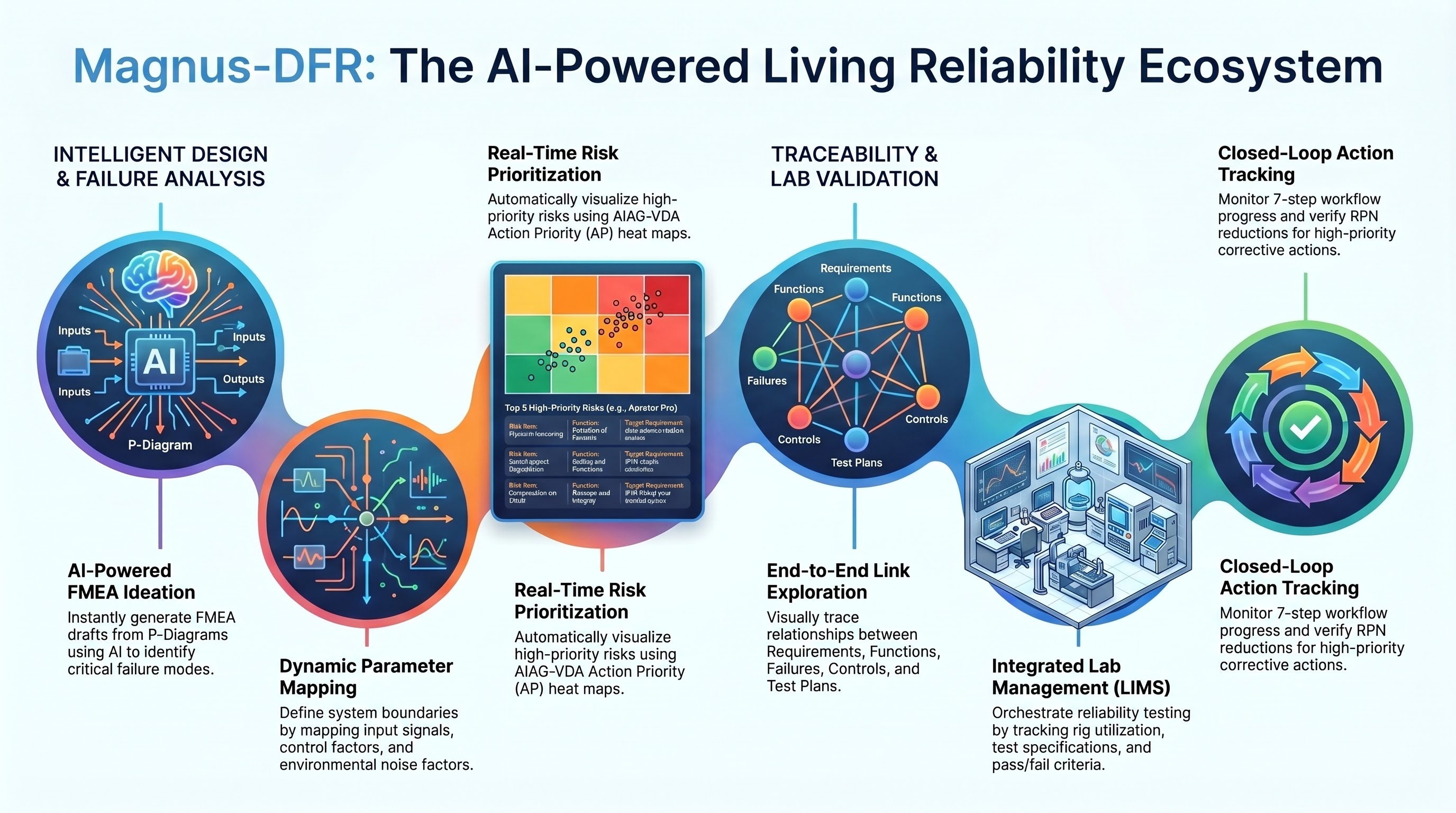
Magnus DFMEA — The AI-Powered Living Reliability Ecosystem
📋
Magnus DFMEA
Design Failure Mode & Effects Analysis

Magnus DFMEA transforms reactive failure analysis into proactive risk-driven design intelligence. Capture every potential design failure mode, score severity, occurrence, and detection, then drive corrective actions to closure — all in a collaborative, real-time environment connected to your entire reliability workflow.

● Problems It Eliminates
Design failures discovered late in validation cost 10-100× more to fix
Tribal knowledge about failure modes walks out the door when engineers leave
Disconnected spreadsheets make it impossible to trace risk from concept to production
No visibility into which design risks are actually mitigated vs. assumed safe
● Key Capabilities
AIAG/VDA-compliant FMEA worksheets with auto-RPN calculation
AI-assisted failure mode and cause suggestions from historical data
Action tracking with owners, due dates, and closure verification
Direct linkage to DVP&R test plans and Quantify statistical evidence
Real-time collaboration across design, quality, and reliability teams

Magnus DFMEA in Action — click any screenshot to enlarge

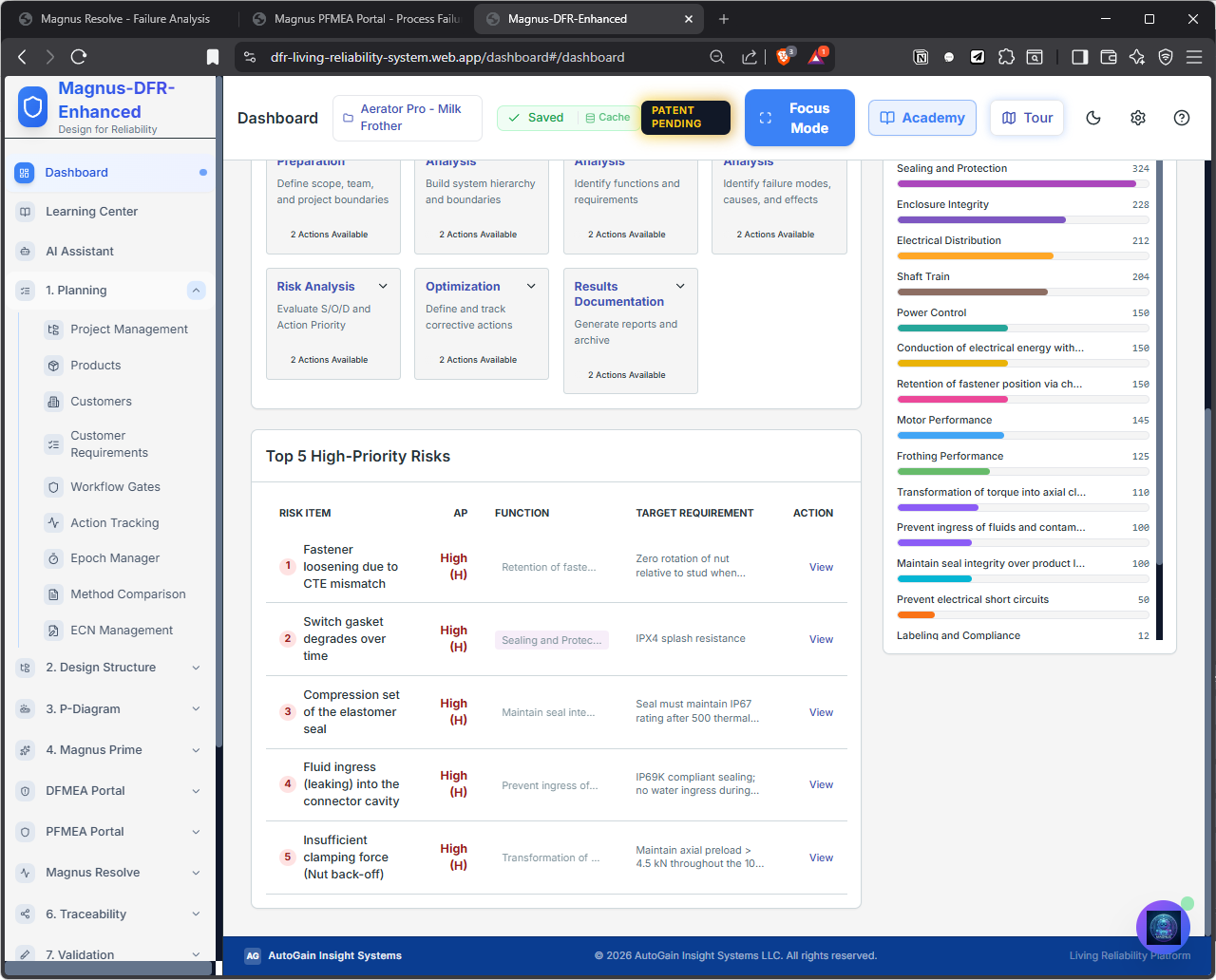
DFMEA Dashboard
Dashboard & Risk Overview
Top 5 risks, AIAG-VDA Action Priority heat map, RPN bar chart
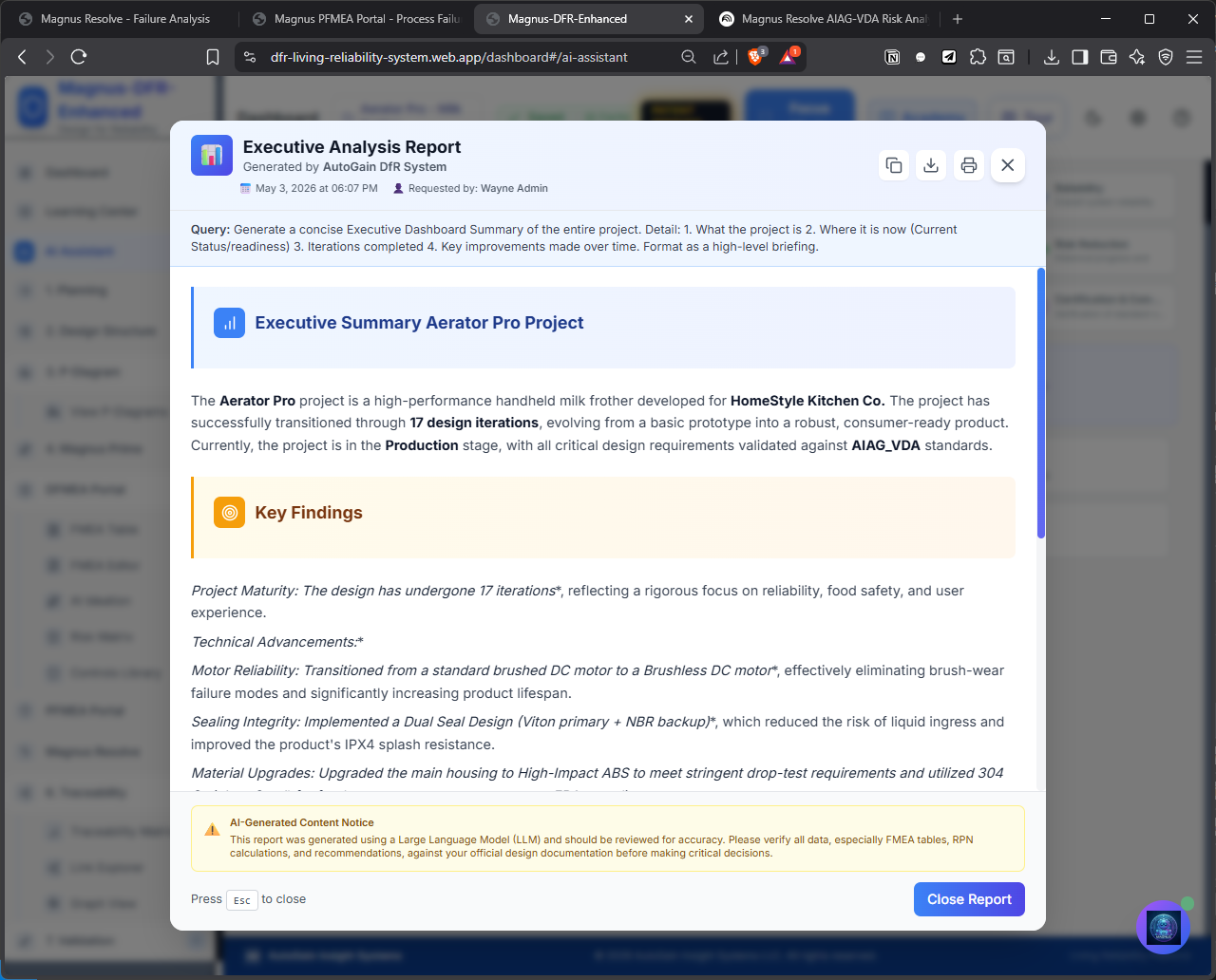
AI Reliability Assistant
Natural language queries, executive reports, risk analysis
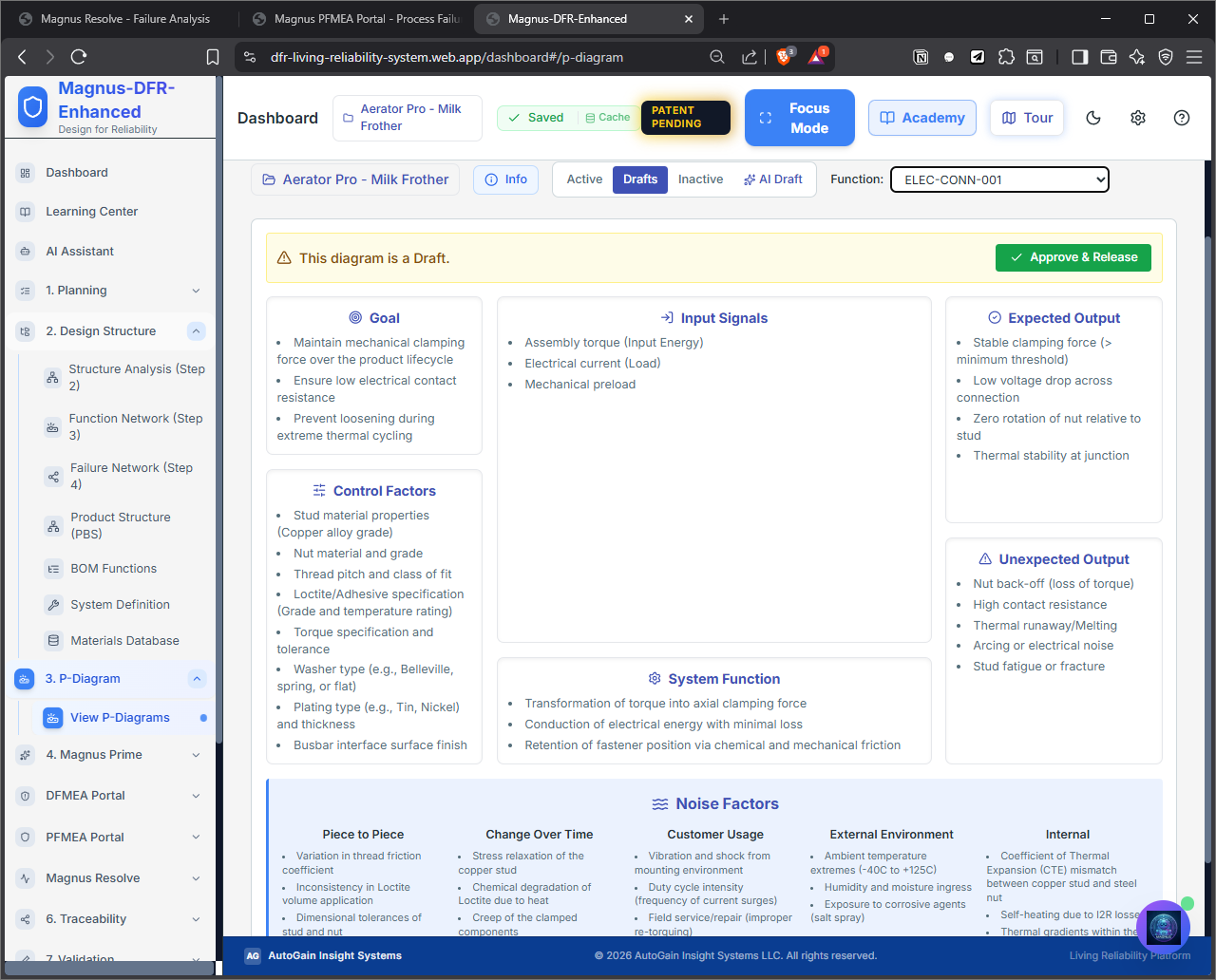
P-Diagram Mapping
P-Diagram Mapping
Input signals, control factors, noise factors, outputs
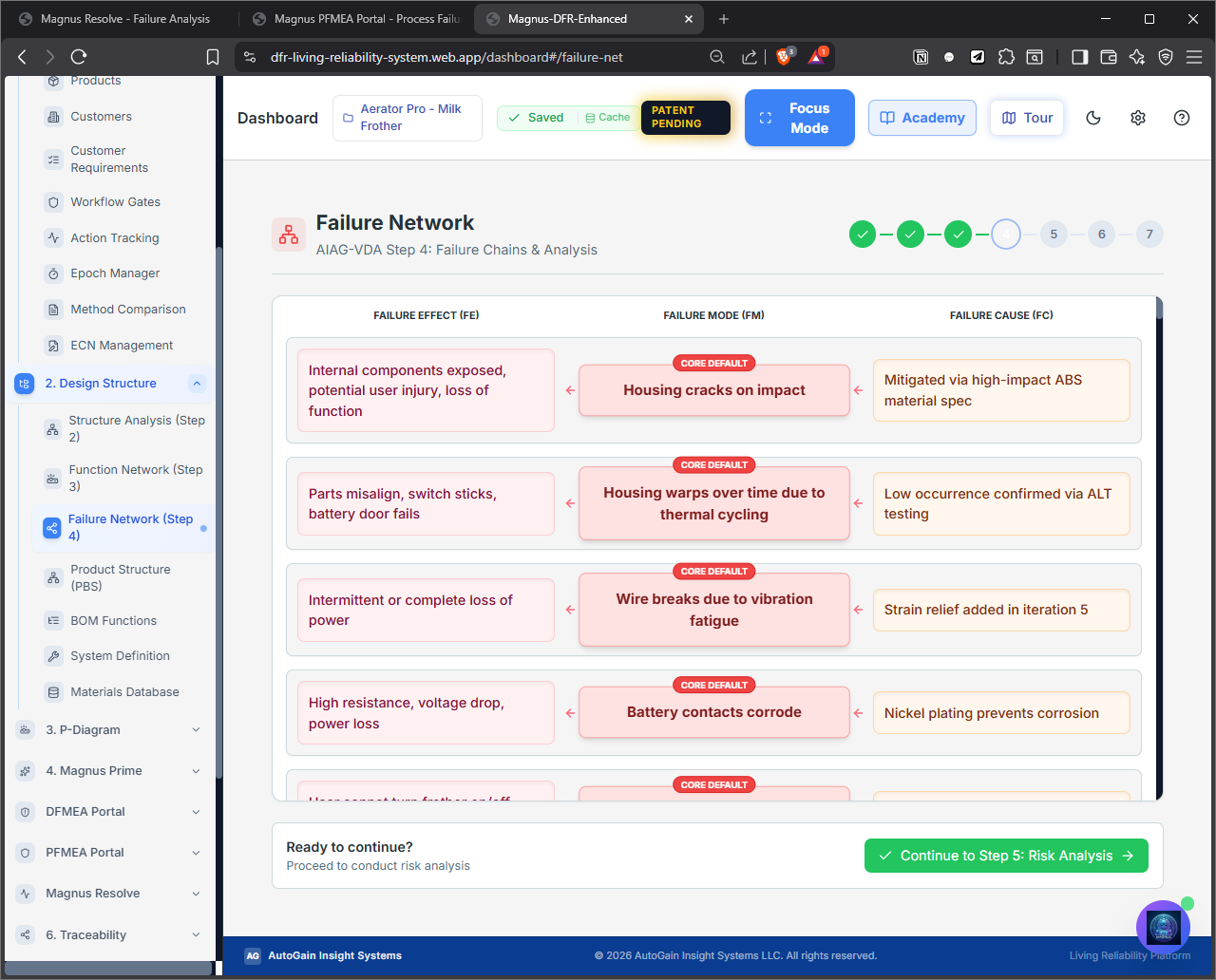
Failure Network Graph
Interactive causal chain visualization
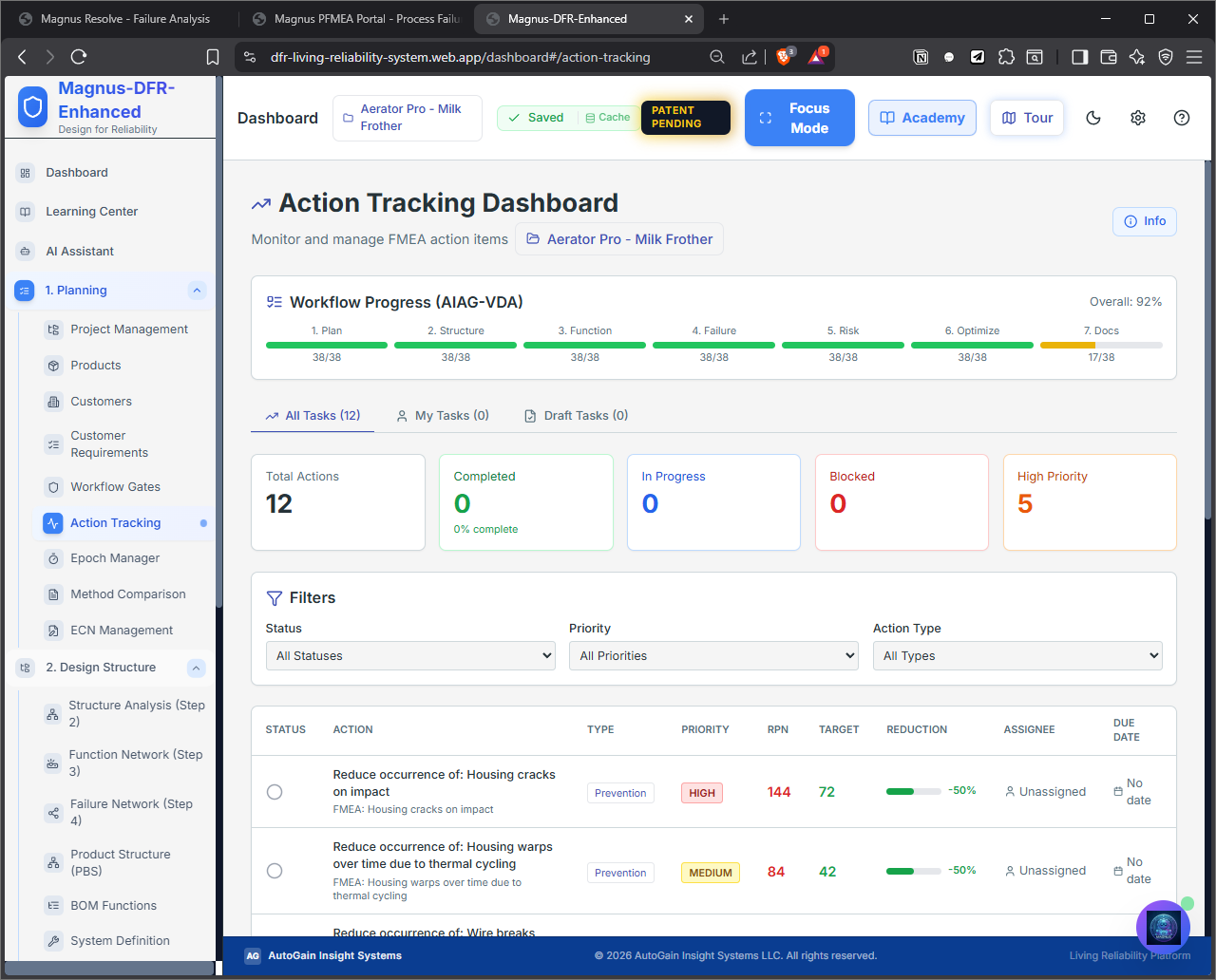
Action Tracker
Action Tracker
Owner assignment, due dates, RPN reduction tracking
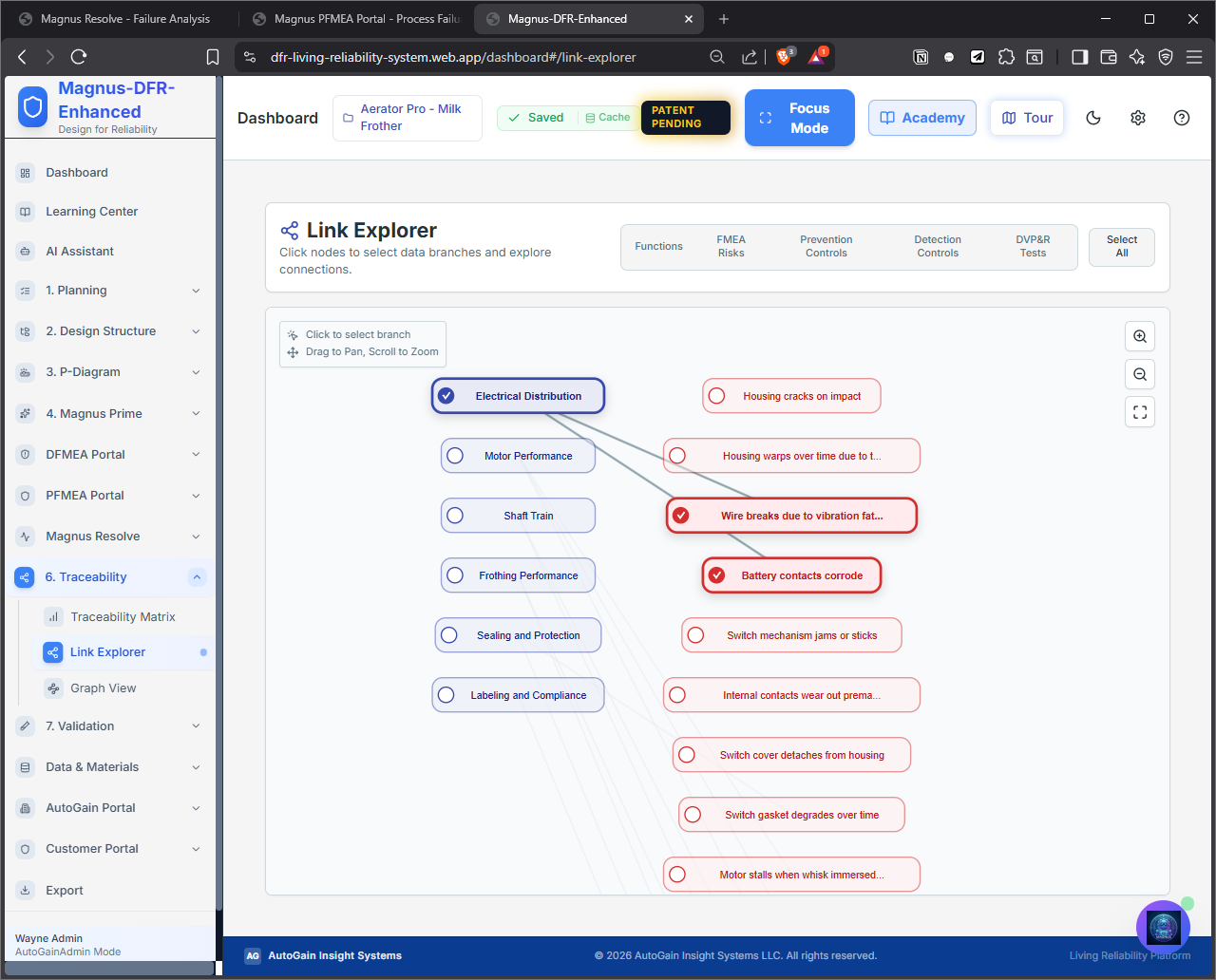
Link Explorer
Link Explorer
Requirements → Functions → Failures → Controls → Tests
Lab Management (LIMS)
Rig utilization, test specs, pass/fail criteria
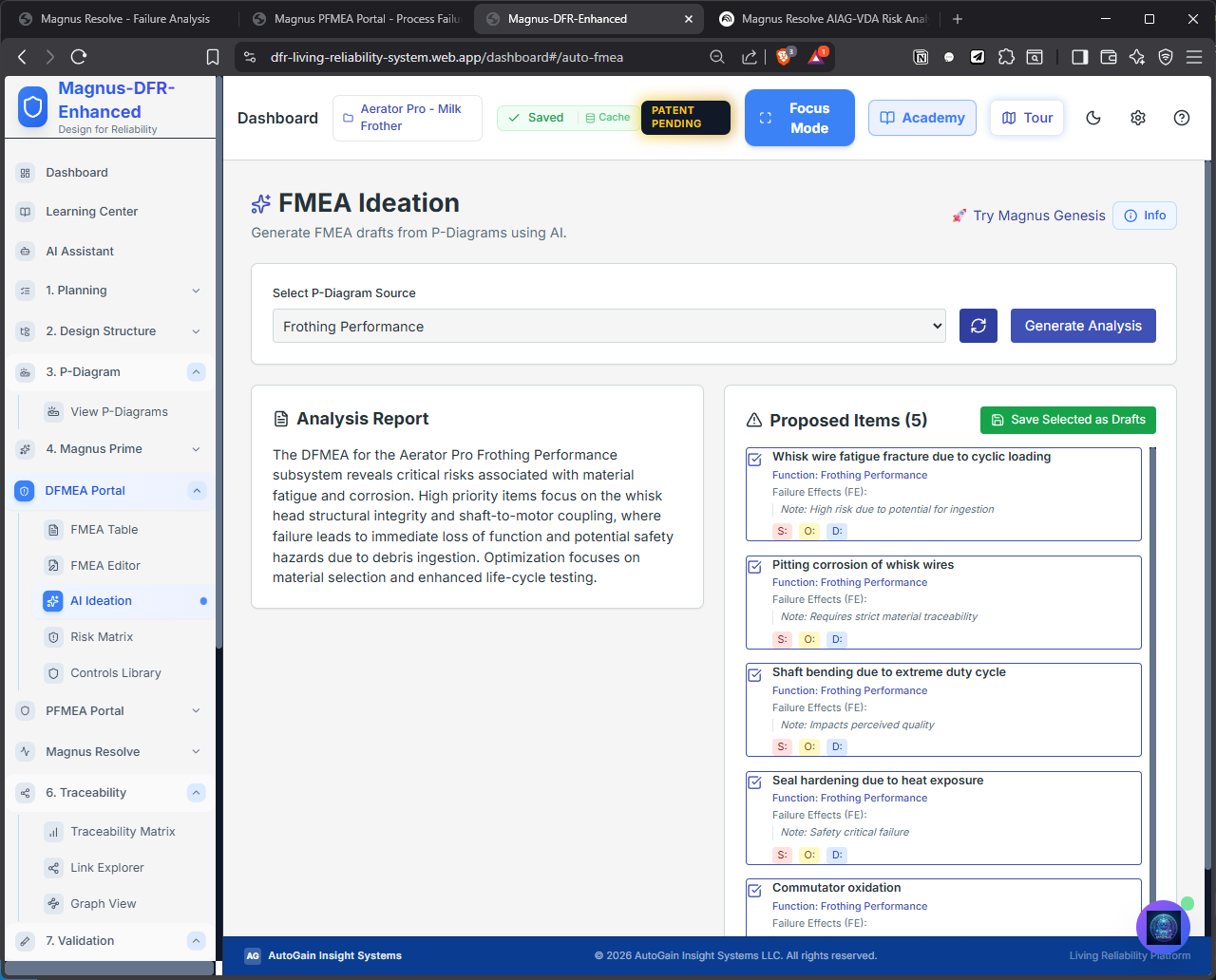
AI FMEA Ideation
AI FMEA Ideation
Generate failure mode drafts from P-Diagrams with AI
DFMEA Dashboard
Dashboard & Risk Overview
Top 5 risks, AIAG-VDA Action Priority heat map, RPN bar chart
AI Reliability Assistant
Natural language queries, executive reports, risk analysis
P-Diagram Mapping
P-Diagram Mapping
Input signals, control factors, noise factors, outputs
Failure Network Graph
Interactive causal chain visualization
Action Tracker
Action Tracker
Owner assignment, due dates, RPN reduction tracking
Link Explorer
Link Explorer
Requirements → Functions → Failures → Controls → Tests
Lab Management (LIMS)
Rig utilization, test specs, pass/fail criteria
AI FMEA Ideation
AI FMEA Ideation
Generate failure mode drafts from P-Diagrams with AI
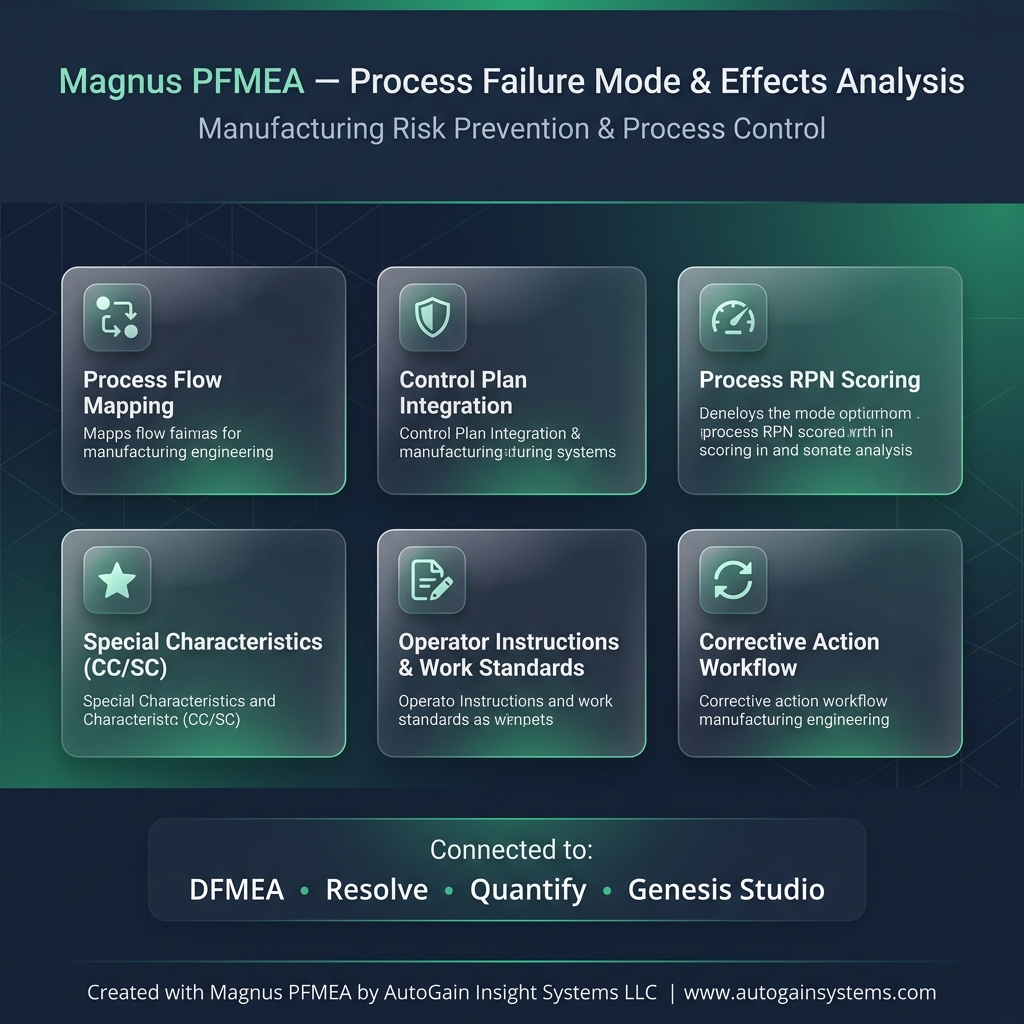
Magnus PFMEA Infographic
🏭
Magnus PFMEA
Process Failure Mode & Effects Analysis

Magnus PFMEA closes the gap between design intent and manufacturing reality. Map your process flow, identify every step where defects can be introduced, and build control plans that prevent escapes before they reach your customer. Integrated with SPC, MSA, and capability data from Quantify.

● Problems It Eliminates
Process-related defects account for 60-80% of warranty claims in manufacturing
Control plans exist on paper but are never updated after launch
Special characteristics (CC/SC) get lost between design and production
No systematic way to connect process risks to actual SPC/capability evidence
● Key Capabilities
Process flow mapping with direct linkage to FMEA risk items
Control Plan generation from PFMEA special characteristics
Severity/Occurrence/Detection scoring with process-specific guidelines
Integration with Quantify SPC charts and process capability indices
Operator work instruction linkage and training record tracking
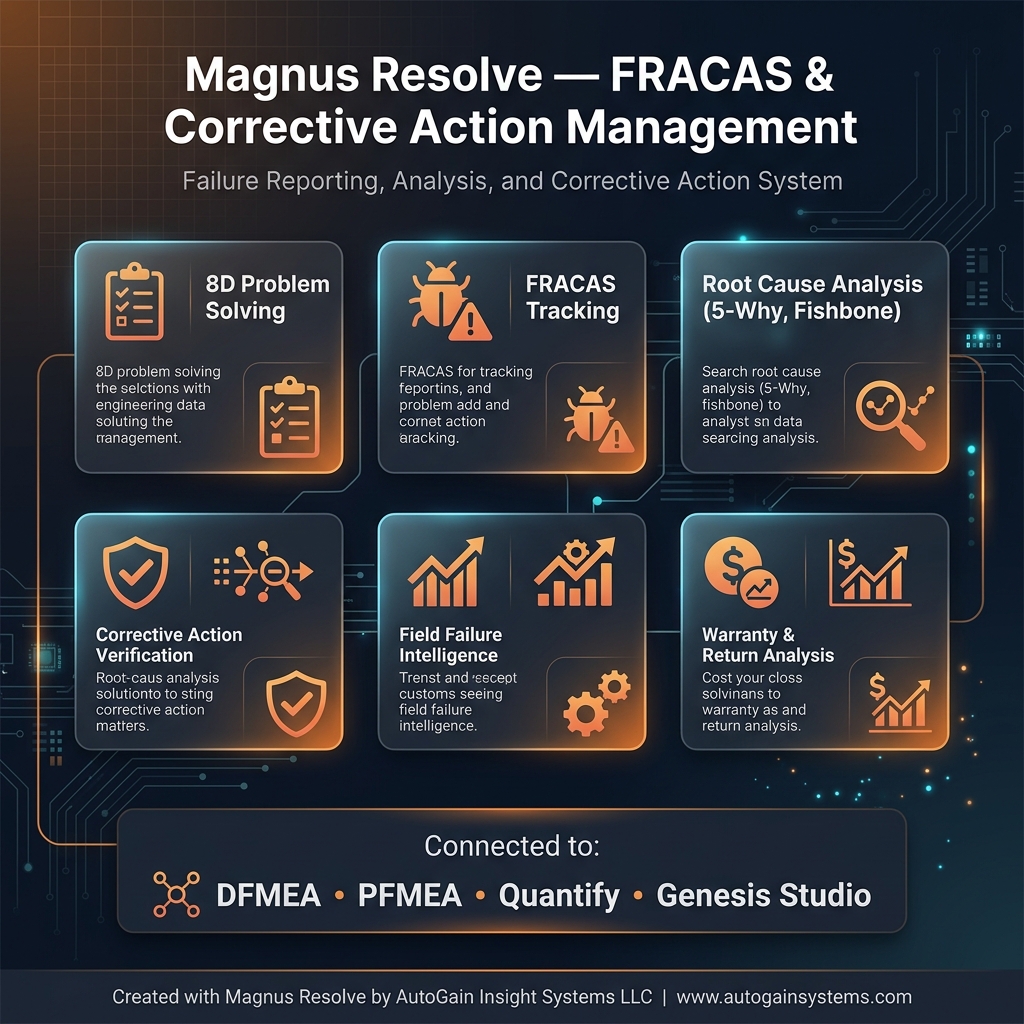
Magnus Resolve Infographic
🔧
Magnus Resolve
FRACAS & Corrective Action Management

Magnus Resolve is your Failure Reporting, Analysis, and Corrective Action System (FRACAS). When things go wrong — in the field, on the line, or in the lab — Resolve captures the failure, drives systematic root cause analysis using 8D/5-Why/Fishbone, and ensures corrective actions are verified effective. Every resolution feeds back into your FMEA and reliability models.

● Problems It Eliminates
Field failures get logged in email threads and spreadsheets — never analyzed systematically
The same failure mode recurs because root causes are assumed, not verified
Corrective actions are implemented but never confirmed effective with data
Warranty costs keep rising because field intelligence doesn't reach design teams
● Key Capabilities
8D Problem Solving with structured D1-D8 methodology
5-Why and Fishbone root cause analysis tools
Corrective action verification with statistical evidence from Quantify
Automatic FMEA feedback: resolved field failures update occurrence scores
Warranty cost tracking and Weibull-based field failure projection
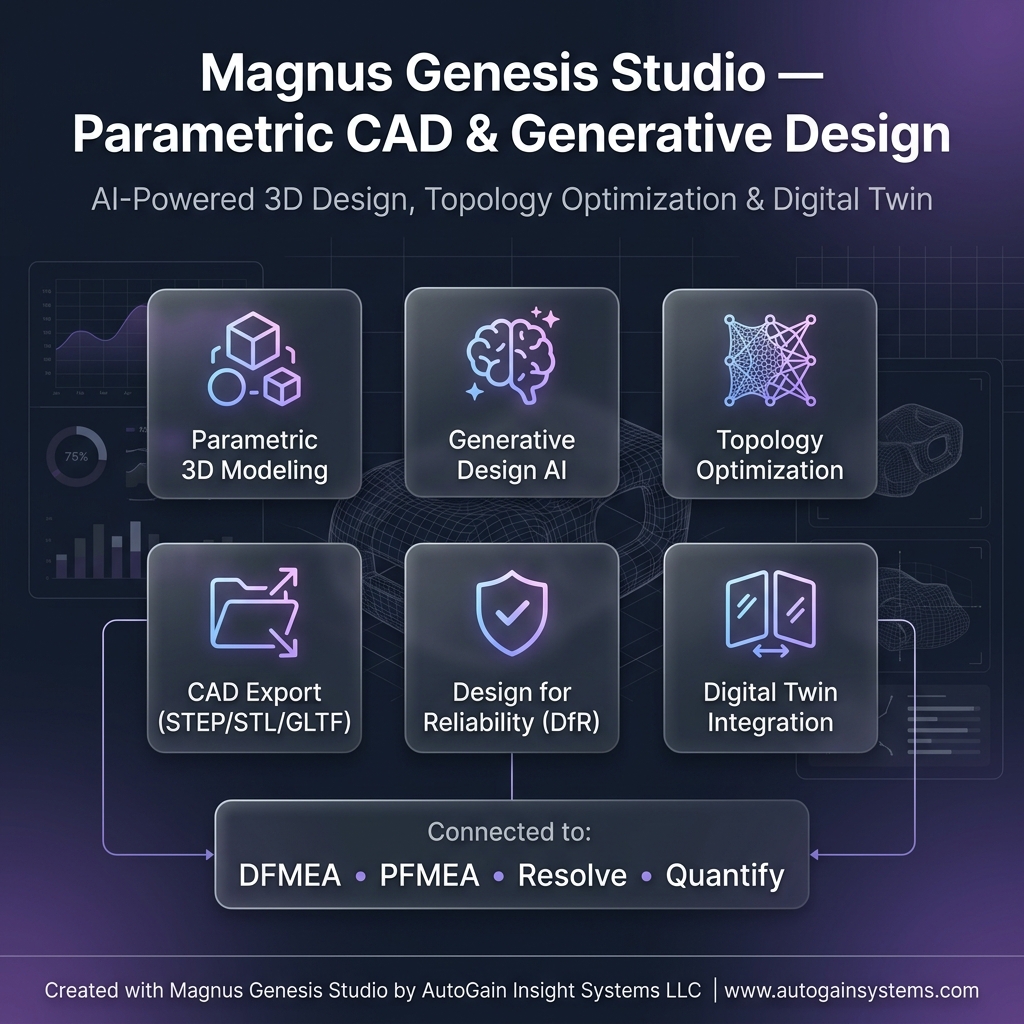
Genesis Studio Infographic
🧬
Magnus Genesis Studio
Parametric CAD & Generative Design

Magnus Genesis Studio brings AI-powered parametric design and generative optimization to reliability engineering. Define your design space with parameters, constraints, and physics — then let Genesis explore thousands of configurations to find the optimal geometry for strength, weight, cost, and reliability simultaneously.

● Problems It Eliminates
Engineers manually iterate on CAD designs without systematic optimization
Topology optimization results are disconnected from reliability analysis
No way to automatically explore the design space for reliability-optimal geometry
Design for Reliability (DfR) principles are applied ad-hoc, not systematically
● Key Capabilities
Parametric 3D modeling with ManifoldCAD geometry kernel
Generative design with multi-objective optimization (strength, weight, cost)
CAD export to STEP, STL, GLTF for manufacturing and simulation
Design for Reliability integration with DFMEA failure modes
Digital twin foundation: parametric models linked to field performance data
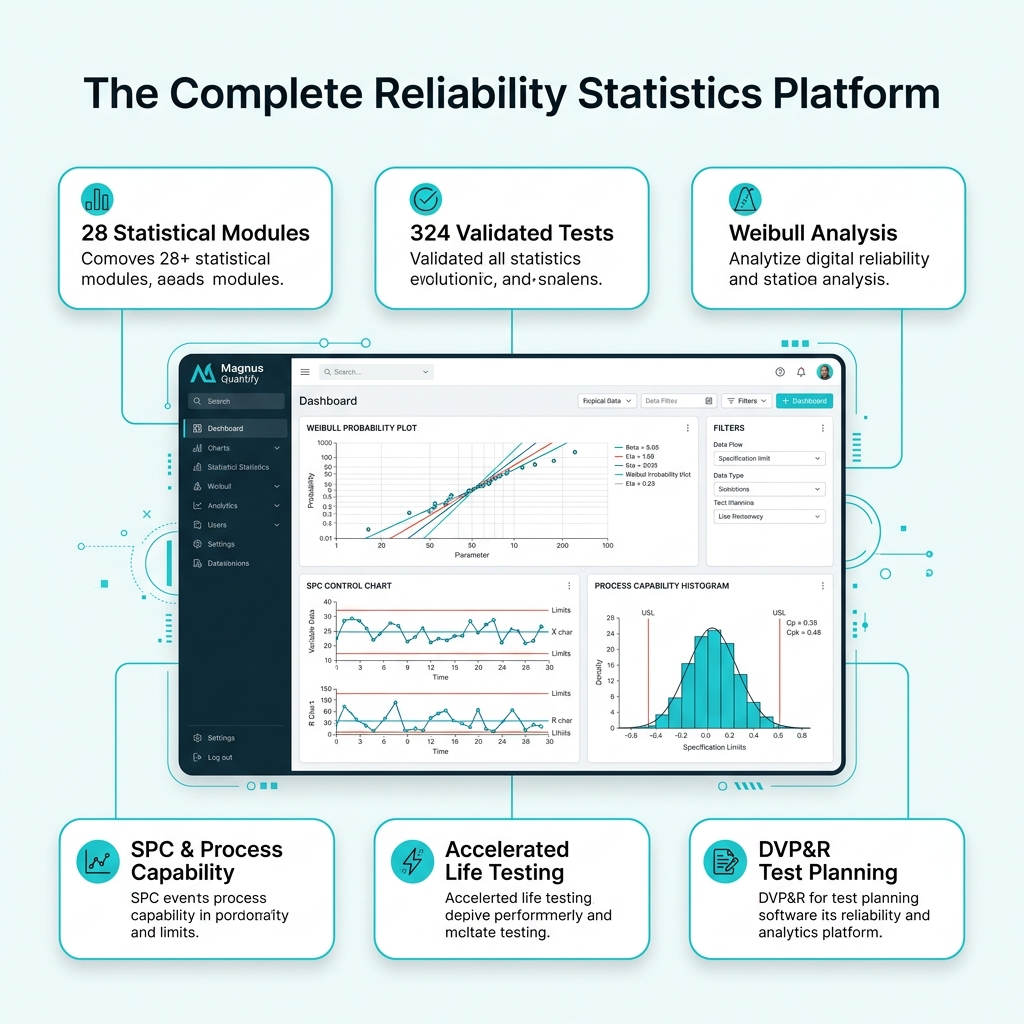
Magnus Quantify — The Complete Reliability Statistics Platform
📊
Magnus Quantify
Reliability Statistics & Analytics Platform

The complete reliability statistics platform — 28 specialized modules, 324 validated tests, 53 worked examples. Weibull life data analysis, SPC, DOE, MSA, accelerated life testing, DVP&R test planning, and warranty analytics — all in one browser-based tool with no coding required.

● Problems It Eliminates
Fragmented toolchain: Minitab for SPC, Weibull++ for life data, Excel for everything else
$5,000–$15,000/seat/year for commercial statistics tools
Statistical results trapped in spreadsheets, disconnected from FMEA risk analysis
Steep learning curve — Python, R, or command-line scripting required
● Key Capabilities
Weibull, Lognormal, Exponential life data analysis with B-life calculation
SPC control charts (I-MR, X-bar/R, X-bar/S, attribute) with Western Electric rules
Accelerated life testing: Arrhenius, Inverse Power Law, Coffin-Manson, Eyring
DVP&R test planning with R90/C95 demonstration and acceleration factor integration
Model Cards on every page — visual explanation of what the analysis does and how
0
AI Agents
0
Physics Domains
0
Standards Covered
0
Statistical Modules
0
Validated Tests
0
Faster FMEAs

The Closed-Loop Advantage

The Living Reliability Loop

Magnus connects every phase of your product lifecycle. Field failures feed back to design. Every cycle makes the platform smarter.

🧬
Design
Genesis Studio
📋
DFMEA
Risk Analysis
🏭
PFMEA
Process Control
🔧
Resolve
FRACAS + 8D
🧠
AI Core
Heritage Learning
⚙️
Production
SPC + MSA
📊
Quantify
Statistics
🌳
Fault Tree
FTA Analysis
🚗
Field
Warranty Data

AI learns from every cycle — the Heritage Learning Database compounds knowledge across all projects.

Standards & Compliance

AIAG-VDA
ISO 26262
IATF 16949
ISO 13485
IEC 61508
98/100 Security Score